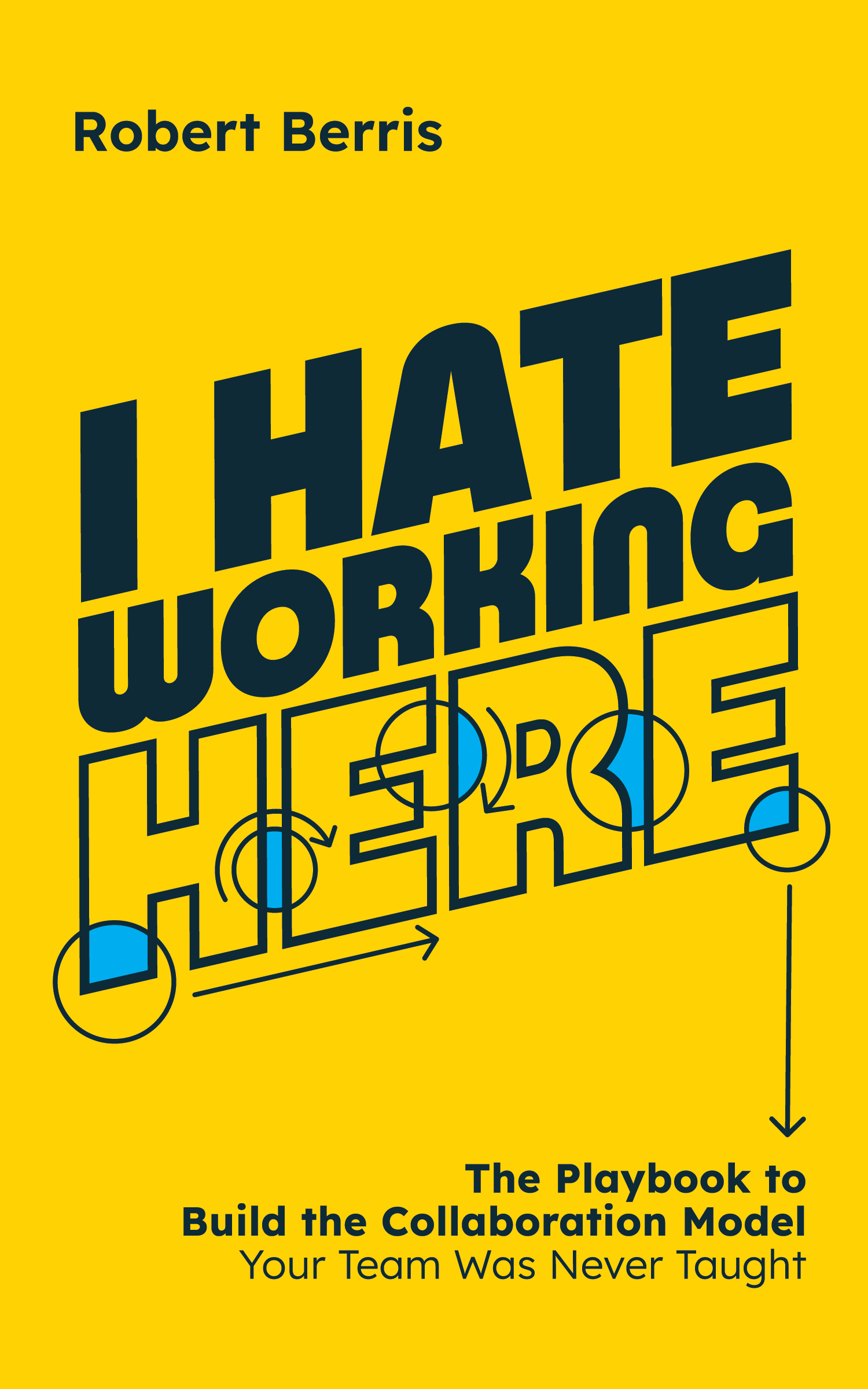
I Hate Working Here
The playbook to build the collaboration model your team was never taught.
Have you ever said it? Not about a job you actually hate—about one you love. A Tuesday that broke you for no reason you could name. A meeting that left you furious and you couldn’t say exactly why. A moment in your week that should have felt like progress and instead felt impossible, like trying to hold an oiled garbage bag full of pudding.
If you’ve never said it, you may be extraordinarily lucky. For the rest of us, it’s one of the most relatable sentences in the working world not because our jobs are bad, but because something underneath them is invisible, unnamed, and almost never fixed.
Here’s what’s underneath it: nobody ever taught you how to work with people. You inherited collaboration the way you inherit a family recipe — by watching whoever happened to be in charge when you got there. You’ve carried it from company to company ever since, never quite sure which parts are worth keeping and which parts are just damage you got used to. So has everyone else in the room. Different norms, different habits, different damage, colliding every day, with no one ever standing up and saying “let’s actually decide how we want to do this.”
We’re not collaborating. We’re co-existing and hoping for the best. And because the five to ten people you work with most are what it feels like to work at your company, this was never just a teamwork problem. Your collaboration is your culture.
A timely, necessary read that should have a spot on every leader’s desk… deceptively simple, so that anyone, anywhere could implement them this week.Milly Tamati — Founder, Generalist World
From the foreword to I Hate Working Here
The cost of leaving it to chance
Collaboration wasn’t working before the pandemic. It isn’t working now. The experts say cancel more meetings and declare no-meeting Fridays. I say your meetings are terrible, not mine. And the numbers are brutal.
Sources: 24 billion hours — Doodle, The State of Meetings Report 2019 (2019); a projection across the U.S., U.K., Germany and Switzerland, based on a Nielsen survey of 1,000 professionals, a four-country survey of ~6,000, and analysis of ~19 million meetings on Doodle’s platform in 2018. $37 billion — John H. Sheridan, “A $37 Billion Waste,” Industry Week 238, no. 17 (September 4, 1989): 11–12. 51% — Mural, 2023 Collaboration Trends Report: Addressing the Collaboration Skills Gap (2023); Qualtrics survey of 3,939 respondents in remote, hybrid and office roles, conducted August 19–September 5, 2022, alongside anonymized Mural and Microsoft Teams usage data.
Collaboration Architecture™
Ask anyone if collaboration matters and they’ll say of course. Ask who taught them how, and watch the pause.
People love planning every detail of the work: timelines, roadmaps, status updates, budgets. But they leave how they actually work together to chance. Few teams ever stop to figure out the best way to work given the challenges ahead of them. Instead, they inherit a working style: whatever habits came from the last boss, the last team, the last company.
Collaboration isn’t a soft skill. It has structure.
For most jobs, the basic building blocks of collaboration are identical: conversations, thinking, decisions, and artifacts are what we spend the most time on. It’s when you step back and look at the Dynamics (the people) and Mechanics (the process) of how a team operates that you start to see the real problems, and the real opportunities for solutions. That’s exactly what this system is built to help you do.
The atoms of collaboration
Before the architecture, the raw materials. Every collaboration you have ever had — good, bad, or baffling — is the sum of four atoms, whether or not anyone noticed. Workshops, stand-ups, instant messages, email, one-on-ones: same four elements underneath, every time.
Conversations
The written and verbal interactions between people on a given topic, in support of doing the work.
Thinking
The frameworks, mental models and biases we consciously or unconsciously bring to the work.
Decisions
Choosing a path forward — guided by stated criteria, unstated assumptions, and norms.
Artifacts
The written and visual representation of the conversations, the thinking and the decisions.
The framework
Collaboration Architecture™ is a system to understand people, use shared principles, and work together with purpose. It stands on four pillars, along two axes — the human forces on one, the operational scaffolding on the other.
Great work emerges when the mechanics and dynamics are well designed. There are plenty of proven methods for making the work itself better. But the work only gets good when the four pillars around it are designed and agreed on — on purpose.
People & purpose
Who is actually in the room, the power that runs between them, and whether everyone is aimed at the same outcome.
Behaviors & mindsets
The habits and reflexes each person brings — and the shared values you choose, on purpose, to replace them with.
Conversation design
Meetings and discussions built for the people in them, with facilitation treated as a real, learnable craft.
Operational rhythm
How often, and in what form, a team gathers to move the work — the right cadence, not just fewer meetings.
Strategy to execution
Not built directly. Strategy as a hypothesis, planning the right work, designing for AI — it emerges when the other four are set well.
Don’t take my word for it.
I talk to operators all week. Every one of them runs a “high-performing” team. Almost none can tell you how the team actually works. Who really gets heard. Where the decision got made. Why Tuesday broke them. That’s the whole game. Nobody teaches it. Robert does. He takes the invisible stuff dragging your team down and makes it something you can design on purpose. Read it. Then go rebuild your next meeting.

Companies love to preach collaboration while systematically setting up silos that make it impossible. Having built strategies for everyone from scrappy startups to Fortune 20 giants, I know this book is the antidote to that corporate paradox. It’s the straightforward playbook teams need to stop talking about “synergy” and actually start working better together.

We’ve all said “I hate working here.” Robert’s eye-opener is that you probably don’t hate your job—you hate how your team works together. As a marketer whose work only succeeds when other teams do too, I’ve watched collaboration make or break both the work and the people doing it. The good news: collaboration has a structure, and this book is how you build it on purpose.

We’ve been put on teams since school, but few of us were ever taught how to collaborate. At work, we assume everyone knows how—and is good at it! What I love about Robert is his focus on the innovators behind the innovations, the people behind the products. If you want to learn what we all should have been taught, I Hate Working Here gives you practical ways to start experimenting with your team!

Pre-order the book
I Hate Working Here is a playbook: step-by-step frameworks, scripts and canvases to design better collaboration for you and your team. Some of it takes a day to do and months to master. Start with your next meeting.